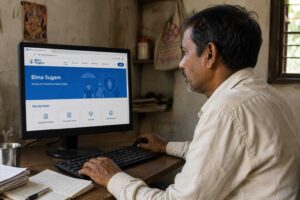
IRDAI Wants Many Bima Sugam: Insurer-Run, Not-for-Profit
Bima Sugam-style digital marketplaces, promoted by insurers and run as not-for-profit companies, are what IRDAI’s consultation paper proposes to add.

Bima Sugam-style platforms could multiply, with IRDAI proposing that each be promoted by at least 11 insurers as a not-for-profit company.
Bima Sugam: The Insurance Regulatory and Development Authority of India (IRDAI) has proposed a new category of insurer-promoted, not-for-profit digital marketplaces, modelled on Bima Sugam, as part of its wider overhaul of insurance distribution. The draft sets out who can set them up, how much of a platform any one insurer can own, and what they can charge.
The proposals appear in the consultation paper “Recalibrating Economics of Insurance Distribution – Part 1: Distribution Reforms,” released in September 2026. The paper calls Market Infrastructure Institutions for Insurance (MIIs) “systemic interventions” to recalibrate the economics of insurance distribution, and describes them as a fully digital, pull-based alternative to the intermediary-led sales model. Public comments are open until October 25, 2026.
Bima Sugam: Ownership, capital and fee rules proposed for new platforms
The paper says an MII must be a not-for-profit company promoted by a group of insurers, with wider participation across the industry. The draft proposes that at least 11 insurers come together to establish one, with no insurer holding significant beneficial ownership.
Once an MII is fully operational, each shareholder insurer would hold less than 10% of the share capital or voting rights. In the formative years, a lead promoter could hold up to 20% to allow timely establishment and operationalisation. That promoter would have to bring its holding down to 15% in five years and to below 10% in seven years.
On capital, the paper proposes ₹25 crore for MIIs, against ₹10 lakh at the entry level for Insurance Distribution Entities. Registration for MIIs, like that for distribution entities, would be permanent subject to payment of an annual fee, instead of the current fixed three-year period.
Also Read: Sidharatha Mishra to head ICICI Life as Anup Bagchi moves to HDFC Bank
MIIs with a mandate to offer a cost-effective, neutral platform for digital purchase of insurance products may be given “preferred distribution status,” the paper says. In return, they would have to operate with a transparent fee structure “much lower” than current distribution commission rates, and give all insurers a level playing field to compete on product features, performance, pricing and the quality of claim settlement and grievance redressal services.
For motor insurance, the paper says such not-for-profit platforms should not charge more than 5% of premium to recover the platform cost. Motor products for both new and old vehicles would need to be available on MII platforms such as Bima Sugam. The overarching objective of these platforms, the paper says, should be to maximise customer value, subject to profitability for insurers.
Where Bima Sugam stands
The paper identifies Bima Sugam as one such MII. It says all insurers except three are shareholders in Bima Sugam India Federation, the company establishing the Bima Sugam digital platform. IRDAI said it expects Bima Sugam to become fully operational with a wide range of life and general insurance products at the earliest. The overview section of the paper puts the timeline at the next four to six months.
The paper notes that other financial sectors already have market infrastructure or financial market infrastructure institutions, including stock exchanges, depositories, clearing corporations, central counterparties, UPI and credit bureaus. It says these have made a transformative impact in securities markets and banking.
The proposals respond to the low share of digital purchases in the paper’s own channel data. In general insurance, brokers account for 33% of premium and individual agents for 30%, while direct online channels contribute about 2% and web aggregators a negligible share. Among private life insurers, direct online business accounts for 2% of premium. The paper also reports that 61st-month persistency in life insurance is 71% for online sales, against 48% across the industry.
Also Read: Car Dealers Earn Up to 38% Commission on Your Insurance. IRDAI Wants to Cut It
To track progress, IRDAI has listed the number of products and business volumes on Bima Sugam, and the number of MIIs promoted by insurers, among the parameters for assessing the reforms.
The paper also proposes using MIIs in the motor segment. Dealers would have to display the option to buy motor insurance on an MII platform, including a QR code, and make new-vehicle buyers aware of it. One of the consultation questions asks whether a mandatory mechanism of offering the MII option to purchasers of new vehicles, with an opt-out, is desirable and practical.
Bima Sugam: Public Insurance Registry proposed as the data layer
Alongside insurer-promoted platforms, the paper proposes the Public Insurance Registry (PIR) as an MII promoted by the Authority itself. It describes PIR as a “Digital Public Infrastructure for Insurance” that is population-scale, interoperable and non-exclusionary, and says it would be built through the transformation of the Insurance Information Bureau. A separate consultation paper on PIR is already in the public domain, according to the document.
IRDAI describes PIR as the national-level, business-facing infrastructure that would enable customer-facing MIIs such as Bima Sugam by helping the public and market participants discover, verify and exchange insurance information consistently. The paper says PIR has 59 potential user stories and would provide verified information on the performance of products, insurers and intermediaries.
Among the functions linked to PIR in the paper:
“Know Your Insurer” and “Know Your Distributor” mechanisms that would put the performance and conduct of insurers and distributors in the public domain.
Public disclosure of mis-selling incidents against individual sales persons, with each policy tagged to the person who sold it.
A seamless portability journey for policyholders.
Validation of a motor customer’s mobile number against the VAHAN vehicle registration database.
A central mechanism, set up on one of the MIIs with back-end support from PIR, to generate a sector-wide functional identity for every insurance distribution person.
Access to commission records on all policies, as prescribed by regulation or by the Authority.
The paper also lists OTP-based verification through an insurer’s service or an MII service among measures to establish a direct and verified connection between customer and insurer before a policy is issued.
The paper says the MII approach is intended to help the sector move from the adage “insurance is sold” to a belief that “insurance is also bought.”
Bima Sugam: Consultation and next steps
The consultation paper asks stakeholders whether they agree with the role of MIIs as a systemic intervention for recalibrating the economics of insurance distribution, and what services they would like to see on such platforms (question 28). Question 27 covers the proposed opt-out mechanism for motor insurance.