IRDAI Wants Premium, Reinsurance and Claim Money to Skip the Middleman
IRDAI wants premiums, reinsurance and claim payments to move directly between stakeholders, cutting out unnecessary middlemen and streamlining the insurance ecosystem.
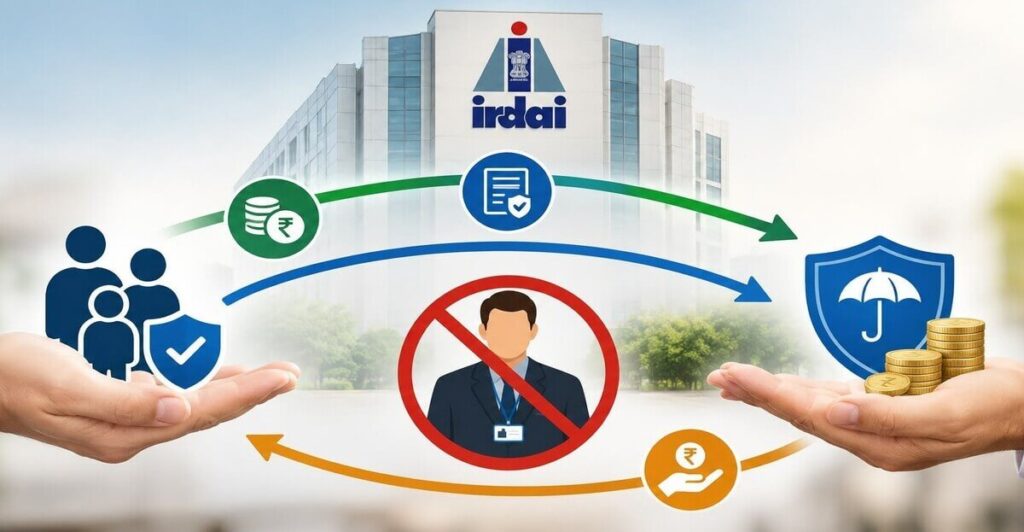
IRDAI is proposing a direct flow of insurance premiums, reinsurance and claim money, reducing reliance on intermediaries.
IRDAI: The Insurance Regulatory and Development Authority of India (IRDAI) has proposed that insurance premium move directly from the customer’s own account to the insurer’s account, with no payments from third parties and no routing through intermediary accounts. The same principle would apply to money flowing between insurers and reinsurers, and to claim payments.
The proposals are part of the consultation paper “Recalibrating Economics of Insurance Distribution – Part 1: Distribution Reforms,” released in September 2026. The paper lists “money should move to where it belongs” as one of four reform measures to improve transparency in the sector. Public comments are open until October 25, 2026.
IRDAI: Premium to be paid from the customer’s own account
The paper says that, under Section 64VB of the Insurance Act, an insurer assumes risk only when it receives the premium. It adds that, for the consumer, the risk must start immediately once he pays, and that the two can converge only if premium moves directly from the customer to the insurer.
IRDAI said compliance with Section 64VB requires the insurer to collect premium before accepting the risk, so it is in the customer’s interest that the money reaches the insurer’s account directly. The paper says there is no additional value in premium moving through any intermediate account, other than under the Bima-ASBA (Applications Supported by Blocked Amount) arrangement, known as BASBA.
On the mode of payment, the paper proposes that only UPI, a credit or debit card, or a bank account of the customer or proposer be used to pay premium, and that third-party payments not be accepted. It says payment only from the proposer’s account has been an established practice in insurance, but that it is not a mandate, which leaves scope for fraud and mis-selling. The proposed direct payment norm is also essential, the paper says, to prevent possible money laundering scenarios and serious frauds.
Also Read: IRDAI Wants Many Bima Sugam: Insurer-Run, Not-for-Profit
IRDAI also said direct movement of premium from customer to insurer would support free choice and eliminate forced bundling of insurance products with non-insurance products. In the section on loan-linked insurance, the paper says an acceptable package offer would require the premium to be paid separately and directly by the customer from his own account, debit card or credit card, and not out of the loan amount.
The draft’s conduct rules for intermediaries follow the same line. Insurance Distribution Entities would be barred from handling customers’ money and from collecting any commission or service fee directly from customers unless regulations specify otherwise. Specified persons, point-of-sale persons, agents and associates would likewise be barred from handling customers’ money.
IRDAI: Reinsurance and claim payments to bypass broker accounts
The paper proposes that funds flowing between an insurer and a reinsurer should also move directly, and not through a broker’s account. This would cover commission, ceding commission and claim payments. A broker’s fee could be paid by the insurer or the reinsurer separately, as per their engagement terms.
For claims, the paper proposes that payment be made directly to the verified bank account of the policyholder or the nominee. Payment instructions from insurers should not be to any bank account, it says, but to the account on record, with the name matched between the insurer’s records and the bank’s records.
The money-flow proposals sit alongside a separate measure on verification. The paper proposes that a direct and verified connection between customer and insurer be established before a policy is issued, irrespective of the channel of purchase. Among the measures listed are OTP-based verification through the insurer’s service or a market infrastructure institution’s service, Aadhaar-based face authentication as an any-time, anywhere self-service for the proposer and insured, confirmation of the customer’s name and number through a Department of Telecommunications service, and a deduplication facility to prevent third-party numbers from being given.
IRDAI: Distributors to be paid within a day of free-look period, with interest on delays
The paper pairs the direct-payment proposals with a timeline for paying distributors. It says distributors need a steady flow of funds to pay their employees and point-of-sale persons, and proposes that they receive commission no later than the day after the free-look period ends, counted from the date the insurer receives the premium, where a free-look period applies.
IRDAI said insurers must strive to find ways to pay within seven days of receiving the premium. The paper says proper claw-back arrangements can be put in place to recover excess payments where policies are cancelled. Any delay would attract interest, which would be charged to the insurer’s operating expenses.
Elsewhere, the paper proposes that all commission, including rewards and related payments, be disclosed through board-approved policies placed in the public domain, and that insurers and distributors maintain records of commission paid and received on every policy, accessible to the Insurance Information Bureau or the proposed Public Insurance Registry. One of the consultation questions notes that proper and timely reconciliation of commissions is necessary so that “commission paid” and “commission received” are identical amounts, and asks how regulated entities can be made more responsible and compliant.