Brokers’ body IBAI Writes to PM Modi on IRDAI Proposals, Flags Risk to 10 Lakh Livelihoods
IBAI asked the government not to notify the regulations until an impact assessment is published. It also asked that the existing expense of management (EoM) framework continue until its scheduled review in 2028.
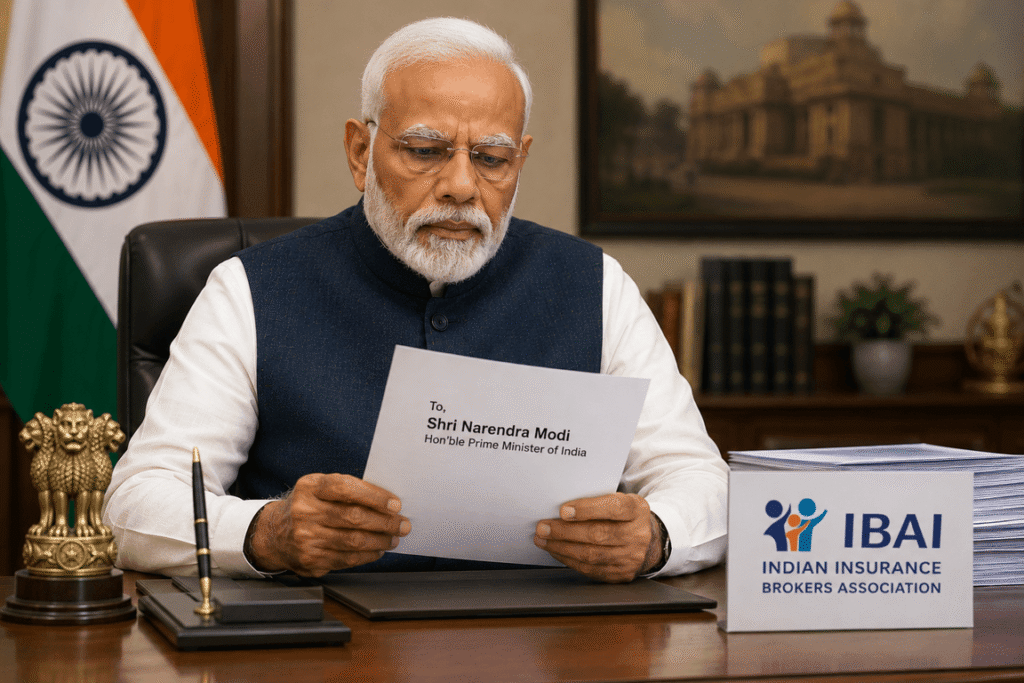
IBAI writes to PM Modi: IRDAI's 30+ commission caps and expense-limit cuts could put 10 lakh livelihoods at risk over five years. AI Generated Image
New Delhi: The Insurance Brokers Association of India (IBAI), the apex body of India’s 798 licensed insurance brokers, has written to Prime Minister Narendra Modi, warning that the Insurance Regulatory and Development Authority of India’s (IRDAI) proposed overhaul of insurance distribution could put at least 10 lakh livelihoods at risk over the next five years, even as it backs the regulator’s push against mis-selling and forced bundling.
In a letter dated October 2 and made public on Monday, IBAI argued that more than 30 product- and channel-specific commission caps, combined with a roughly one-third cut in insurers’ overall expense limits, would hurt employment, competition and insurance penetration. The letter, signed by IBAI President Narendra Bharindwal, says the cost reduction would shift from distributors and insurers’ employees to the owners of insurance companies, with no provision to pass any of it on to policyholders.
IBAI asked that no regulation on commission or expense limits be notified without a published impact assessment covering policyholders, employment, public sector insurers and foreign investment. It also asked that the 2023 framework run to its scheduled 2028 review, and requested an audience with the Prime Minister before October 25 to present its concerns.
IBAI: What IRDAI has proposed
The letter responds to a consultation paper titled “Recalibrating Economics of Insurance Distribution,” which IRDAI released on September 23. Comments are open until October 25, and the proposals are a draft that may change.
According to analysis of the paper, general insurers’ expense of management (EoM) limit would fall from 30 per cent of gross premium to 25 per cent within two years and 20 per cent within five. For life insurers, it would move to 15 per cent within two years and 12.5 per cent within five.
Also Read: Policybazaar Can Survive Even a “Zero Commission World”, Says PB Fintech’s Yashish Dahiya
The paper also proposes all-inclusive, product- and channel-specific commission caps. These include a cap as low as 2 per cent on single-premium credit-life policies and nil commission for distribution entities on third-party motor cover attached to new vehicles. It would restrict compulsory insurance bundling with loans and sort distributors into three categories. It also allows 10 to 20 per cent additional commission headroom for smaller towns and rural areas..
IBAI’s concerns
Citing IRDAI data for FY25, IBAI said insurance distribution employs more than 83 lakh professionals, including individual agents, micro-insurance agents and point-of-sale (PoS) persons. Brokers sponsor 14.81 lakh of India’s 27.18 lakh PoS persons and 62 per cent of motor insurance service providers, most of them self-employed in Tier-II and Tier-III towns, it said.
The 10 lakh figure is what IBAI called a preliminary and conservative estimate over the five-year transition, made before counting insurers’ salaried staff. The letter says a one-third expense cut cannot be met through efficiency alone and would be met by reducing sales, servicing and claims staff at private and public sector insurers. It adds that a detailed estimate is available on request. IBAI also said distribution reach would shrink just as the Insurance for All by 2047 goal requires more of it, with penetration at 3.7 per cent of GDP against a global average above 7 per cent.
IBAI said sub-caps would encourage payments through alternative mechanisms such as overriding commissions, recreating the conditions that produced ₹824 crore of bogus GST input tax credit claims at 15 insurers before 2023. It said public sector insurers, which are bound by government audit, could lose market share again, citing a fall from 65 per cent to about 36 per cent under the earlier product-wise cap regime. Smaller insurers and standalone health insurers, whose fixed costs cannot shrink in proportion to a percentage limit, would also face a non-level playing field, it said.
Follow us on Twitter for latest updates
On the evidence for the proposals, IBAI said that by the paper’s own figures the highest payouts sit in forced-sale channels, where the policyholder has no choice. It cited 42 to 45 per cent for loan-linked credit life and up to 75 per cent for dealer-controlled motor, against 17 to 18 per cent for independent brokers and agents and 6 to 11 per cent for brokers serving corporate clients. It also noted that general insurers’ management expenses fell from 28.2 per cent of premium in FY23 to 26.5 per cent in FY25 while premium grew 13 per cent a year, and that the reported rise in commission largely reflects reclassification of payments previously booked under other heads.
The letter says ₹87.3 of every ₹100 of premium is paid out as claims. It puts the general insurance loss ratio at 82.88 per cent in FY25 and 84.8 per cent in FY26, and says commercial-lines premiums are at historic lows.
IBAI called the proposals the third expense regime in a decade, after 2016 and 2023, and estimated that listed insurers and distributors lost about ₹1.5 lakh crore in market value on the first trading day after the draft’s release. It said 18 of the top 20 insurance markets by premium do not cap commissions on commercial lines, and that printing commission on the policy goes beyond the practice of leading markets and invites rebating, which the Insurance Act prohibits.
On MSMEs, IBAI said the paper proposes removing the ₹5 crore sum-insured limit on cover distributed by lenders, which it argued would extend coerced selling to larger MSME risks..
What IBAI proposes
Instead of hard commission caps, IBAI recommended retaining the 2023 EoM framework, with tighter computation rules if needed and a realistic transition that allows for scale and new entrants. For force-sold insurance, it proposed that insurers refund premium or reduce renewal premium where the claims ratio stays below a prescribed floor, which it suggested could be 65 per cent. It cited the Pradhan Mantri Fasal Bima Yojana (80:110) and Ayushman Bharat (85:115), and the United States and Germany in health insurance, as precedents.
Also Read: Why Is RBI Worried About Policyholders Surrendering Their Life Insurance Policies?
The letter closes by saying it is not an argument against reform but “an argument for reform that reaches the policyholder.”
In an earlier statement on September 29, IBAI said the paper relies in places on outlying commission and margin figures that do not represent industry averages.