Nepal Flash Flood: GIC Re’s Losses Contained as Global Reinsurers Bear the Brunt of Claims
Nepal flash flood damaged critical hydropower assets and knocked out over 12% of the country’s power generation capacity.
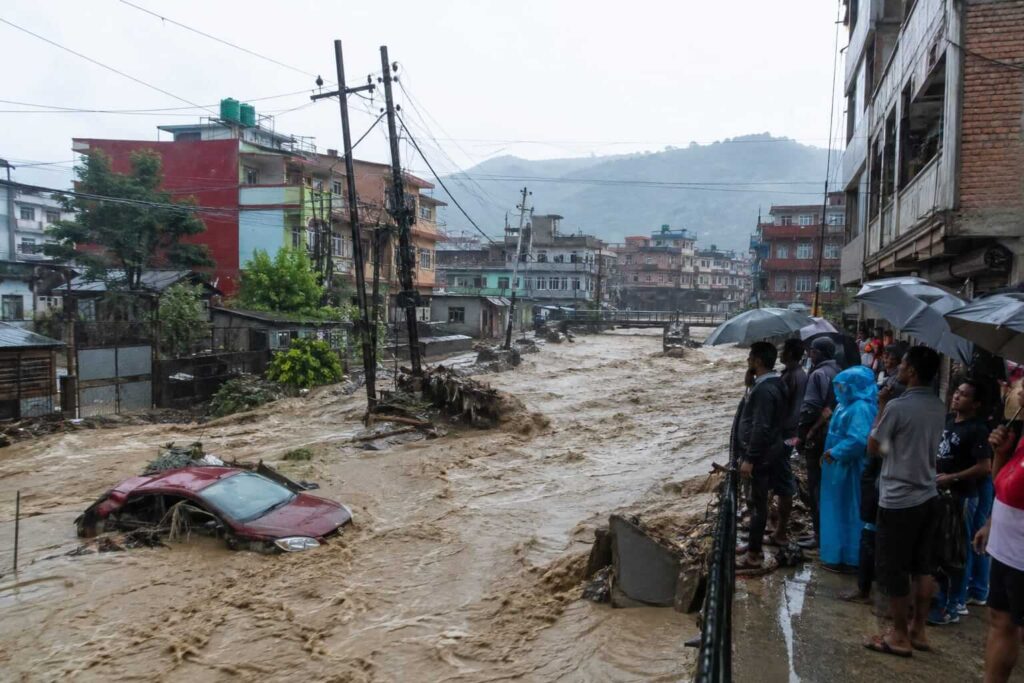
Nepal flash flood in the Rasuwa district damaged critical hydropower infrastructure and triggered sharp stock market declines.
Nepal Flash Flood: The catastrophic flash floods that tore through Nepal’s Rasuwa, Nuwakot and Dhading districts on August 26, 2026, have triggered one of South Asia’s most significant insured-loss events in years, damaging critical hydropower infrastructure, roads and border trade points. Yet General Insurance Corporation of India (GIC Re), the country’s largest reinsurer and a longstanding risk carrier for Nepal’s insurance market, is expected to see its direct financial exposure remain contained — with a large share of the claims burden instead flowing to international reinsurance capacity.
Nepal Flash Flood: What Happened Rasuwa Flood Disaster
A massive ice-and-rock avalanche near Langtang Lirung triggered a cascading flash flood down the Lhende Khola–Bhote Koshi–Trishuli river system on the morning of August 26. The flood tore through dozens of settlements across Rasuwa, Nuwakot, Dhading, Gorkha, Tanahun, Nawalparasi and Chitwan districts, and completely destroyed the Gyirong Port complex on the China–Nepal border, a major gateway for regional trade and tourism.
At least 734 deaths and nearly 2,500 people missing have been confirmed in Nepal, with an additional 16 dead and hundreds missing across the border in the Tibet Autonomous Region of China. Officials have confirmed that 32 bridges and nearly 25 miles of road were swept away, including the entire route connecting Betrawati in Nuwakot to the Rasuwagadhi border crossing with Tibet.
The disaster also struck at the heart of Nepal’s energy sector. The Nepal Electricity Authority reported damage to as many as 14 hydropower projects with a combined capacity of roughly 748 megawatts, along with a 220 kV substation — knocking out more than 12% of the country’s national generation capacity in a single morning.
Nepal Flash Flood: Insurance and Financial Markets Feel the Shock
The scale of the physical destruction was matched by a swift reaction in Nepal’s financial markets. The Nepal Stock Exchange (NEPSE) index dropped 35.92 points, or 1.38%, as hydropower and non-life insurance shares came under heavy selling pressure. Of the 13 sub-indices trading that day, the hydropower index fell 2.84%, while the non-life insurance index posted the steepest decline of any sector, dropping 3.90%.
Nepal’s Insurance Authority said it had received information on damage to around 13 hydropower projects — those already producing 354 megawatts, plus projects under construction with a combined capacity of 394 megawatts, together totalling roughly 748 megawatts. Affected projects reported in Rasuwa include Upper Trishuli 1, Rasuwagadhi Hydropower, Rasuwa Bhotekoshi, Upper Mailung A, Sanjen Khola, Langtang Khola and Chilime Hydropower, several of which are publicly listed companies.
Nepal Flash Flood: Why GIC Re’s Direct Hit Is Expected to Be Limited
Industry sources note that primary insurers — and by extension their reinsurance partners — will not absorb the full cost of the disaster alone. While the complete extent of the destruction remains unknown, primary insurers are not expected to bear the entire financial burden, as reinsurers are set to absorb a significant portion of the eventual losses.
Nepal’s insurance framework spreads catastrophe risk widely across both domestic and international reinsurance markets, which is central to why any single reinsurer’s exposure — including GIC Re’s — is structurally limited. According to Nepal’s Insurance Authority, hydropower projects under construction are typically covered through engineering insurance, while completed projects are covered through property insurance. Critically, the insured amount for a project under construction does not necessarily match its full construction cost, rising only as the build progresses — meaning some projects under construction have insured only an amount equal to their outstanding bank loans, while completed projects generally carry property cover for the full asset value.
The share of that risk passed outward to reinsurers is substantial. Around 80% of the insurance burden for projects under construction is typically transferred to reinsurance companies, while for completed-project property insurance, some insurers retain up to 50% of the risk themselves and cede the rest. Under existing regulatory arrangements, only 30% of the amount ceded under property reinsurance must be placed with domestic reinsurers — leaving the remaining 70% available to be picked up by international markets.
That regulatory structure has increasingly favoured foreign capacity over GIC Re in recent years, both in Nepal and in GIC Re’s home market. GIC Re’s share of India’s own reinsurance market has fallen from 74.2% in 2019 to 51% in 2023, as licensed foreign reinsurers — including Munich Re and Swiss Re — have expanded their branch presence following 2018 regulatory changes that allow foreign reinsurers to underwrite domestic business directly. Foreign reinsurers’ share of gross written premiums in India nearly doubled over the same period, from 25.8% to 49%, according to data from GlobalData. A similar dynamic plays out in Nepal, where multiple international reinsurers now compete alongside GIC Re and Nepal Reinsurance Company for cession business.
Nepal Flash Flood: A Strategic Retreat from Catastrophe Risk
GIC Re’s contained exposure to the Rasuwa disaster also reflects a deliberate shift in the reinsurer’s global risk appetite, announced just weeks before the floods struck. Speaking in Mumbai in June, GIC Re chairman Hitesh Joshi said the state-owned reinsurer intends to increase its focus on casualty and specialty lines internationally while reducing its reliance on overseas property and catastrophe business, citing rising climate-related losses worldwide. “To the extent feasible, depending on our internal analysis, we should rebalance our exposure to natural catastrophes,” Joshi said, pointing to flooding in traditionally lower-risk regions such as South Africa and Dubai, alongside increasingly severe hurricanes, typhoons and cyclones, as evidence of shifting global risk patterns.
The numbers behind that pivot are significant. GIC Re said floods, wildfires and severe storms accounted for 92% of its insured catastrophe losses in 2025, underscoring how weather-related risk is spreading across a wider range of regions and business lines. The reinsurer operates in 137 countries and processed premiums worth ₹443 billion in the 2025-26 financial year, with about 25% of its business currently coming from international markets — a share the company wants to grow to around 40% within three to five years, but increasingly through casualty and specialty lines rather than property catastrophe risk.
Nepal Flash Flood: Nepal’s Domestic Reinsurance Market Under Separate Pressure
Nepal Flash Flood: While GIC Re’s exposure appears manageable, Nepal’s own domestic reinsurer is under considerably more strain. Nepal Reinsurance Company Limited recorded a loss of Rs 5.84 billion in the first nine months of fiscal year 2025/26, a sharp reversal from a profit of Rs 548.2 million in the same period a year earlier, driven primarily by claim expenses that more than doubled, from Rs 5.17 billion to Rs 10.83 billion. Declining investment returns compounded the pressure, with investment income falling from Rs 942.6 million to Rs 475.4 million as interest rates softened in the domestic banking sector.
Nepal’s regulators have already moved to tighten reinsurance discipline in response to the country’s mounting catastrophe exposure. A recent directive requires insurers operating in Nepal to reinsure at least 20% of the sum insured they underwrite directly with Nepal Reinsurance Company, while non-life insurers must structure catastrophe reinsurance so that net retention does not exceed 10% of net worth.
Nepal Flash Flood: The Bigger Picture: A Pattern, Not a One-Off
This is not the first time Nepal’s difficult terrain and seismic instability have tested GIC Re’s balance sheet. Following the 2015 magnitude-7.8 earthquake that killed more than 7,500 people, GIC Re — then Nepal’s largest reinsurer — estimated its maximum loss from that disaster at about $160 million, reinsuring business with 13 Nepalese non-life companies and accounting for roughly a quarter of the country’s total insurance market at the time. GIC Re’s gross exposure to the Nepalese insurance market then stood at around $140 million, and the corporation said it expected its own claims to stay under $50 million even in a worst-case scenario.
More recently, Nepal’s exposure to catastrophic and socio-political risk has continued to climb. The September 2025 “Gen Z” protests in Kathmandu exposed Nepal’s insurance and reinsurance sectors to major losses tied to civil unrest, with early estimates from the hotel sector alone pointing to losses exceeding NPR 25 billion (roughly US$177 million), alongside additional multi-billion-rupee losses among retail chains and vehicle dealers. AM Best had warned at the time that higher-than-expected retention at the company level could threaten capital adequacy for domestic reinsurers with limited reserves, even as global reinsurers maintained strong capitalisation overall.
Nepal Flash Flood: What Comes Next
With search and rescue operations still ongoing and a second glacial barrier lake being monitored for further breach risk, the final insured-loss figure from the August 2026 floods remains fluid. What is becoming clear, however, is the shape of the claims distribution: Nepali primary insurers will process the bulk of policyholder claims on damaged hydropower and infrastructure assets, but the financial burden behind those claims will be shared across a widening panel of reinsurers — domestic and international — rather than concentrated in any single carrier.











1 thought on “Nepal Flash Flood: GIC Re’s Losses Contained as Global Reinsurers Bear the Brunt of Claims”