Gold Jewellery Insurance in India: What It Covers, What It Costs, and How Claims Actually Work
Gold jewellery insurance in India can help safeguard valuable ornaments against theft, loss and damage. Here’s what policies typically cover, how premiums are calculated and how the claims process works.

Gold jewellery insurance can protect valuable ornaments against risks such as theft, burglary and accidental damage, depending on the policy.
Gold Jewellery Insurance: To understand why jewellery insurance has become a live conversation in India, start with the price chart. Ten grams of 24-karat gold, which cost roughly Rs 29,150 in 2017, has climbed as follows:
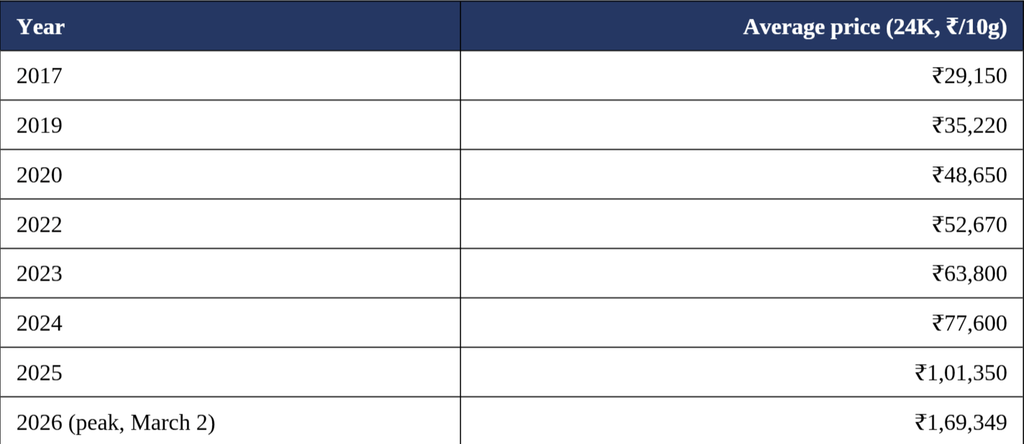
That is roughly a 480% increase over nine years. A mangalsutra or a pair of bangles bought in 2017 for Rs 1.5 lakh in gold value alone would, at today’s rates, represent well over Rs 7 lakh worth of metal — often without the owner ever formally re-declaring that value to an insurer, a bank locker, or even to themselves.
This gap between what jewellery is worth on paper and what it is actually worth today is precisely the exposure that jewellery insurance is designed to close.
Gold Jewellery Insurance: What “Coverage” Actually Means, Item by Item
Jewellery insurance policies in India are typically built around six categories of risk:
- Theft, burglary and robbery. Triggered by forced entry, housebreaking, or an act of robbery or snatching — the single most common claim category.
- Fire and related perils. Loss or damage from fire, explosion, lightning or smoke, usually bundled under home-insurance-linked cover.
- Natural calamities. Floods, cyclones, earthquakes, landslides and similar events.
- Accidental damage. A chipped stone, a bent setting, a broken clasp — covered by some standalone and premium policies, often with a sub-limit.
- Accidental loss. A ring that slips off, an earring lost in transit — a narrower cover offered by fewer insurers, usually with a higher excess.
- Transit and worldwide cover. Protection for jewellery carried or worn while travelling, including outside India, available under some standalone floater policies.
What is consistently excluded: gradual wear and tear, stones lost from a setting that was already weakening, and any damage traceable to neglect rather than a sudden event. Insurers underwrite for the unexpected, not for the slow erosion of a decades-old piece.
Also Read: GSB Seva Mandal’s Mahaganapati Insured for Record ₹703.27 Crore Ahead of 72nd Ganeshotsav
Gold Jewellery Insurance: A Real Case That Shows the Scale of the Risk
The exposure isn’t theoretical. In one Bengaluru case reported by Deccan Herald, a woman was targeted while walking near her apartment when a man on a motorbike asked for directions, then snatched her 50-gram gold chain and fled, injuring her in the process.
The police investigation that followed led to the arrest of a serial offender and the recovery of 541 grams of gold ornaments across multiple cities — Hyderabad, Palakkad and Bengaluru — worth an estimated Rs 52.89 lakh, tied to 11 separate cases including 10 chain-snatchings and a daylight robbery. In another Bengaluru case, police recovered stolen jewellery, silver utensils and two motorbikes worth Rs 20 lakh from a single burglary-and-snatching operation.
These are not isolated incidents — they illustrate why insurers and retailers increasingly frame snatching and housebreaking as the two risks a jewellery-specific policy needs to address first.
Gold Jewellery Insurance: Three Routes to Getting Jewellery Insured — and Where Each One Falls Short
- 1. Home insurance jewellery rider. Jewellery is added to a homeowners’ or renters’ policy as part of household contents. This is often the cheapest route, but most home policies cap jewellery cover — sometimes at a flat aggregate limit regardless of how many pieces a household owns. A family holding, say, Rs 8 lakh in jewellery against a policy that caps contents-linked jewellery cover at Rs 2–3 lakh would find the bulk of their collection effectively uninsured unless each high-value piece is separately declared and scheduled.
- 2. Standalone jewellery floater policy. Each piece is declared individually by description and value, insured independently of any home policy, and — critically — can travel with the owner, including internationally. This is the preferred route once a household’s jewellery value crosses a few lakh rupees, precisely because it avoids the aggregate caps of a rider.
- 3. Jewellers Block Policy. A commercial product for jewellers, manufacturers and diamantaires, not individual consumers. It bundles cover for stock in vaults (often with a deductible starting around Rs 5 lakh), stock in transit — including movement through traditional angadia courier networks — and stock on consignment at exhibitions. Reported premium rates for high-security, established commercial premises run roughly 0.5–1.5% of the declared sum insured annually; standalone or lower-security locations are priced higher.
Gold Jewellery Insurance: Doing the Premium Math
Because jewellery insurance is typically priced as a percentage of declared value, the arithmetic scales directly with what gold is doing. On a Rs 5 lakh jewellery collection, an indicative 0.5–1.5% annual rate translates to roughly Rs 2,500–7,500 a year in premium — a small fraction of the value being protected, and a smaller fraction still now that the same physical gold, bought a few years ago, may already be worth double what it was declared at.
This is also why insurers ask for updated valuation certificates periodically: a policy underwritten against a 2020 valuation will under-insure 2026 gold by roughly the same 250% that prices have risen over that period.
Gold Jewellery Insurance: What You Need on Hand
Across nearly every policy type, insurers ask for a jeweller’s valuation certificate establishing current worth, plus the original purchase invoice where available. To actually process a claim, insurers typically require a police complaint or First Information Report for theft, robbery or burglary claims, photographs or other documentation of the loss event, and the valuation records used to fix the claim amount.
Missing paperwork — particularly an outdated valuation — is one of the most common reasons claim settlements fall short of an owner’s expectations.
Gold Jewellery Insurance: The Newer Model: Insurance Bundled at the Billing Counter
A more recent shift in the Indian retail jewellery market has seen individual jewellers integrate insurance directly into the point of sale, in partnership with dedicated insurance-tech platforms. Instead of a customer researching and buying a policy separately after the purchase, coverage — typically against theft, robbery and housebreaking — is activated automatically as part of the transaction.
One such platform has stated it works with several hundred retail partners across multiple Indian states, covering jewellery collectively valued in the thousands of crores of rupees, with claim settlement rates it has put at around 98%. The logic behind the model is straightforward: the biggest barrier to jewellery insurance has historically been the extra step required to buy it, and removing that step at checkout converts a product people intend to get around to into one they already have.
Gold Jewellery Insurance: The Bottom Line
Gold’s near five-fold rise since 2017 has quietly outpaced how most Indian households think about insuring what they own. Whether the right fit is a home-insurance rider, a standalone floater, or coverage bundled in at the time of purchase, the practical questions are the same: is the declared value current, is the documentation in order, and does the policy actually cover the risk — snatching, housebreaking, robbery — that Indian jewellery owners report facing most often.